Severance is almost always negotiable, even when AI is the stated reason for layoff. Federal law (OWBPA) gives workers 40+ a 21-day consideration window for individual offers (45 days for group layoffs) plus a 7-day revocation period after signing. Beyond cash, you can negotiate equity acceleration, COBRA extensions, outplacement, removal of non-compete language, and PTO payout. Anchor your counter against Meta's 16-week starting package, not Oracle's 4-week floor.
Severance is almost always negotiable. The employer needs your signature on a release of legal claims more than you need their first offer, which gives you real leverage. Oracle, Meta, and Google have all settled severance disputes above their initial offers in 2026. The first number is a starting position, not a final one.
Under the federal Older Workers Benefit Protection Act, if you are 40 or older you must be given at least 21 days to consider an individual severance offer, or 45 days if it is part of a group layoff. You then have 7 more days to revoke after signing. Even if you are under 40, you have the right to take time to review the agreement, ideally with an attorney, before signing.
More than most people realize. The full menu typically includes: additional weeks of pay, accelerated equity vesting (especially RSUs scheduled to vest soon), extended COBRA or health coverage, outplacement services, a positive reference clause, removal of non-compete or non-solicit language, payment of accrued PTO, and the ability to keep your laptop or company devices. Equity acceleration alone can be worth more than the cash severance.
Yes. AI is the explanation, not a legal barrier. Forrester's 2026 research found that 55% of employers regret AI-driven layoffs and half of those laid off are quietly rehired, often at lower salaries. Your leverage on severance has nothing to do with the reason for the cut. It depends on potential legal claims, the value of the release the employer wants, and whether your package is competitive with peers. Reference public benchmarks like Meta's 16-week starting package when anchoring.
Signing on the day of the layoff meeting. The pressure to sign immediately is real but almost always artificial. Take the full 21 or 45 days the law allows, have an employment attorney review the agreement, and counter in writing with specific asks (weeks of pay, equity acceleration, COBRA, reference clauses). The cost of a one-hour attorney consult is a fraction of what most negotiations recover.
The median job search now takes 108 days and two-thirds of seekers have been rejected by an AI before a human ever saw their resume. Mass-applying is dead. Here is the data-backed 2026 playbook for getting hired — and getting paid — faster.
16 states now require employers to publish salary ranges. California's new law took effect this January. Here is how to turn that transparency into a bigger paycheck.
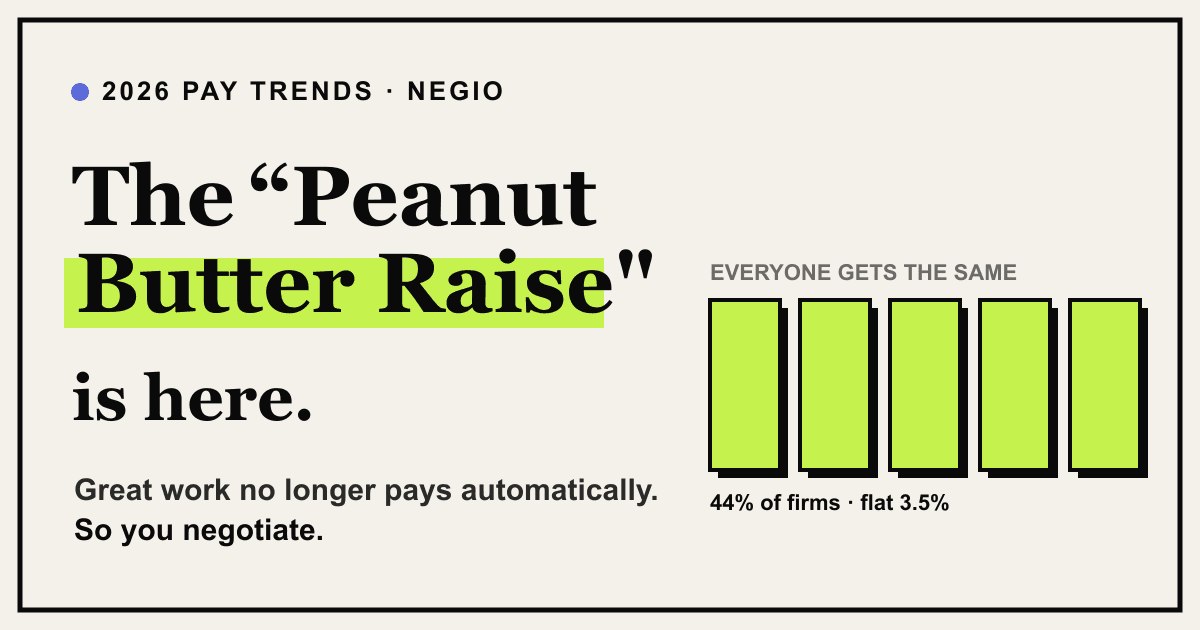
Your raise this year may have nothing to do with how well you performed. In 2026, a growing share of employers are spreading pay increases evenly across everyone — a 'peanut butter' approach that quietly punishes high performers. Here is the data, and the negotiation playbook for getting paid on merit when your company has stopped doing it for you.
The 2026 layoff wave is being sold as an AI transformation. The math behind it tells a different story. As of mid-May, 179 layoff events have hit 113,863 individuals in 2026, averaging roughly 863 job losses every day. Oracle alone announced cuts of 30,000 workers. Forrester's Predictions 2026 report found that 55% of employers regret laying off workers for AI, and half of those terminated are quietly rehired, frequently offshore or at significantly lower salaries.
The companies announcing these cuts are not having a transformation problem. They are having an accountability problem. And for the workers in the middle of it, the question is not whether AI is real. The question is what is in the envelope they hand you on your way out, and whether you can negotiate it higher.
The answer, in almost every case, is yes.
Before the deep dive, here are the five questions that show up in every severance conversation in 2026, with answers grounded in current law and recent precedent.
Is severance actually negotiable, or is the first offer final?
Severance is almost always negotiable. The employer needs your signature on a release of legal claims more than you need their first offer, which gives you real leverage. Oracle, Meta, and Google have all settled severance disputes above their initial offers in 2026. The first number is a starting position, not a final one.
How long do I have to sign a severance agreement in 2026?
Under the federal Older Workers Benefit Protection Act, if you are 40 or older you must be given at least 21 days to consider an individual severance offer, or 45 days if it is part of a group layoff. You then have 7 more days to revoke after signing. Even if you are under 40, you have the right to take time to review the agreement, ideally with an attorney, before signing.
What can I negotiate besides the base severance pay?
More than most people realize. The full menu typically includes additional weeks of pay, accelerated equity vesting (especially RSUs scheduled to vest soon), extended COBRA or health coverage, outplacement services, a positive reference clause, removal of non-compete or non-solicit language, payment of accrued PTO, and the ability to keep your laptop or company devices. Equity acceleration alone can be worth more than the cash severance.
Can I negotiate severance if my employer claims it is being eliminated because of AI?
Yes. AI is the explanation, not a legal barrier. Forrester's 2026 research found that 55% of employers regret AI-driven layoffs and half of those laid off are quietly rehired, often at lower salaries. Your leverage on severance has nothing to do with the reason for the cut. It depends on potential legal claims, the value of the release the employer wants, and whether your package is competitive with peers.
What is the biggest mistake people make with severance offers?
Signing on the day of the layoff meeting. The pressure to sign immediately is real but almost always artificial. Take the full 21 or 45 days the law allows, have an employment attorney review the agreement, and counter in writing with specific asks.
The 2008 financial crisis layoffs, the 2023 tech contraction, and the 2026 AI wave all look similar on a press release. The mechanics of the severance conversation are not the same.
What is new in 2026 is the explanation. Companies have discovered that "we are using AI" is a story shareholders accept without scrutiny. According to TIME's reporting on Oracle, employees were asked to train AI replacements before being terminated. The Register reported that many of the AI capabilities cited as justification do not yet exist in production form. The result is that companies cut staff to satisfy a narrative, then face a productivity gap they fill by quietly rehiring through offshore arms or contracting agencies.
For workers, this matters in two specific ways:
The honest answer: standard is whatever your employer hands you, plus whatever you negotiate on top.
The most common 2026 benchmark is "one to two weeks of base pay per year of service," with a floor of two to four weeks and a cap somewhere between 16 and 26 weeks. Where companies land on that range varies more than most people expect.
| Company / Tier | Starting Package | Per Year of Service | Cap |
|---|---|---|---|
| Oracle (May 2026) | 4 weeks | +1 week / year | 26 weeks |
| Meta (recent rounds) | 16 weeks | +2 weeks / year | varies by tenure |
| Google (recent rounds) | 16 weeks | +2 weeks / year | 60+ weeks (long tenure) |
| Typical mid-size tech | 2 to 4 weeks | +1 to 2 weeks / year | 16 to 26 weeks |
| Typical non-tech corporate | 2 to 4 weeks | +1 week / year | 26 weeks |
The Oracle versus Meta gap is a useful anchor. According to Yahoo Finance's reporting on the Oracle layoffs, at least 90 Oracle employees signed a public petition asking the company to match the terms of other big tech firms. Oracle declined. But the comparison itself is the leverage. When you can say "Meta's package is 4x yours for the same tenure," you have moved the conversation from "is this fair" to "what number closes this."
Negio's negotiation planner builds these benchmarks directly into your strategy document. It pulls the public severance ranges for your industry and tenure, layers in any specific facts about your role, and outputs the exact ask language to use in your counter-offer email.
Ready to put this into action?
Negio builds a personalized negotiation strategy based on your role, market rate, and situation, backed by the same research you just read.
Try Negio freeThe biggest unforced error in severance negotiations is assuming "severance" means "cash." It does not. The package is a bundle of monetary and non-monetary terms, and almost every line is on the table.
Monetary terms:
Health and benefits:
Non-monetary terms:
The single highest-leverage move in a 2026 severance negotiation is to identify your three most valuable asks across this list before responding to the initial offer. Vague "I want more" is weak. Specific "I want 8 additional weeks, full RSU acceleration through end of Q3, and a written reference clause" is strong.
The single most common mistake people make is responding to a severance offer with a phone call. Phone calls drift. Written counters anchor. Here is a template that works in 2026, adapted from the structure recommended by the Harvard Program on Negotiation for high-stakes asks.
Subject: Severance Agreement — Counter-Proposal
Hi [HR / Manager Name],
Thank you for sending the severance agreement on [date]. I am taking the full 21-day [or 45-day] review period the agreement provides, and after reviewing it carefully, I want to propose a revised version that I believe reflects both my contributions over [X years] and the broader market for severance packages at companies of comparable size.
Specifically, I would like to propose:
1. Severance pay: An increase from [X weeks] to [Y weeks] of base pay. This brings the package closer to the published benchmarks at [comparable companies, e.g., Meta's 16-week starting package].
2. Equity acceleration: Full vesting of RSUs scheduled to vest within 90 days of my termination date. This is consistent with the standard approach taken by [reference company] in similar circumstances and reflects the retention purpose of the original grants.
3. COBRA coverage: 6 months of employer-paid COBRA premiums instead of 1 month, to bridge the gap to new employer coverage in a difficult hiring market.
4. Reference clause: Inclusion of a positive reference clause in which HR confirms dates of employment and provides a neutral-to-positive description if contacted by prospective employers.
5. Non-compete and non-solicit: Removal of the non-compete clause and narrowing of the non-solicit clause to current direct reports only, for a 12-month period.
I would like to resolve this collaboratively and remain available to discuss by phone or video if helpful. Please let me know if you can confirm by [date approximately 7 days out] whether these terms are acceptable.
Best regards, [Your name]
The email works because it does five things at once. It anchors with specifics. It cites comparable benchmarks. It frames the asks as a collaborative resolution. It sets a deadline (which most companies will honor because they want closure). And it leaves everything in writing for follow-up.
Negio's salary coach can adapt this template to your exact situation: your tenure, your company size, your equity position, and the specific weak points in the initial offer. Most users walk out with a finished counter-email in under 15 minutes.
This is the most common pushback in 2026 layoff conversations. "The offer is standard. We cannot negotiate." Oracle's HR team responded to employee group petitions with cookie-cutter rejections. The script is familiar.
It is also frequently untrue.
Tactic 1: Ask which specific term is non-negotiable. "Standard package" usually means the base weeks. The non-base terms (equity acceleration, COBRA, reference language, non-compete scope) often have separate approval paths. Force the conversation onto specific lines.
Tactic 2: Surface a competing benchmark. "I understand the policy. Can you walk me through how the package compares to [Meta's recent layoff terms]? I want to make sure I am evaluating it correctly before I sign."
Tactic 3: Mention legal review. You do not need to threaten litigation. A simple "I am working with an employment attorney to review the agreement" frequently triggers a second look from HR, particularly if there are any age, gender, race, or disability factors in the layoff selection.
Tactic 4: Use the time the law gives you. The 21- or 45-day review period is yours. Use it. Companies running large layoff waves want releases signed quickly. Slow-walking the response is itself leverage.
Tactic 5: Practice the conversation before it happens. Negio's practice mode puts you in a simulated negotiation with an HR representative who will tell you the offer is fixed. You can rehearse exactly how to respond before you hear it for real.
The "final offer" tactic works because it sounds authoritative and because most people are too rattled by the layoff itself to push back. The data is consistent across every reputable source: severance terms move when employees push, and almost never get worse when they push politely and in writing.
| Stat | Finding | Source |
|---|---|---|
| Tech layoffs in 2026 YTD | 113,863 individuals, 179 events | The AI Insider |
| Average daily job losses | 863 | The AI Insider |
| Oracle layoff size | ~30,000 workers | TIME / The AI Insider |
| Employers regretting AI layoffs | 55% | Forrester Predictions 2026 |
| AI layoffs quietly rehired | ~50% (often offshore / lower pay) | Forrester |
| OWBPA review period (individual, 40+) | 21 days | Federal law |
| OWBPA review period (group layoff, 40+) | 45 days | Federal law |
| OWBPA revocation period | 7 days after signing | Federal law |
| Oracle starting severance | 4 weeks + 1/year, 26-week cap | Oracle / Yahoo Finance |
| Meta starting severance | 16 weeks + 2/year | Meta / Yahoo Finance |
Most workers freeze when they are handed a severance agreement. The shock of the meeting, the pressure to sign, the worry that pushing back will hurt the reference or the rehire chances — all of it conspires to produce a signature on the day of the layoff, before any of the actual leverage has been used.
Do not be that person. The 21-day clock is a gift. The market benchmarks are public. The release of legal claims is worth real money to your employer. None of that changes because they led with the word "standard" or because the press release mentioned AI.
Build your severance counter-offer with Negio. Pull the public benchmarks for your industry, identify the three highest-value asks for your specific situation, and draft the email that will get the package moved. Free to try, ten messages with a coach trained on the 2026 research, no credit card.
Sources: TIME — Oracle Workers Trained Their AI Replacements, Yahoo Finance — Oracle Workers Tried to Negotiate Severance, The AI Insider — Oracle AI-Driven Mass Layoff, HR Executive — The AI Layoff Trap (Forrester Predictions 2026), The Register — AI Layoffs Backfire, Drew Lewis Law — How to Negotiate Your Severance Agreement (2026), Harvard Program on Negotiation — How to Counter a Job Offer, Metaintro — Silent Firing 2026