Yes, in real take-home terms. RTO mandates cost the average worker $561 per month in commuting, childcare, lunches, and clothing, roughly 7 to 15% of net take-home pay. Stanford research values hybrid work at an 8% raise equivalent, and tech workers value fully-remote arrangements at up to 25% of total compensation. The salary on paper does not change, but real compensation drops.
Yes, but the strategy has changed. Worker leverage has dropped. Only 7% would quit over RTO now, down from 51% a year ago. Ultimatums no longer work, but structured negotiation still does. Frame flexibility as compensation with specific dollar values, anchor with data, and offer alternatives like base salary increases, commute stipends, or accelerated promotion timelines if remote work is non-negotiable.
Total compensation is almost always more flexible than base salary alone. Ask for a base salary adjustment of $5,000 to $15,000 to offset RTO costs, a monthly commute or home-office stipend, additional PTO, an accelerated promotion timeline, or relocation support if the office is far. Calculate your specific RTO cost in dollars first, then anchor your ask to that number.
Frame it as a comp conversation, not a personal one. Cite external data such as Stanford research valuing hybrid at an 8% raise equivalent, and offer specific alternatives like a base salary adjustment if full-time in-office is non-negotiable. Stay collaborative, propose solutions, and avoid emotional language about commutes or stress.
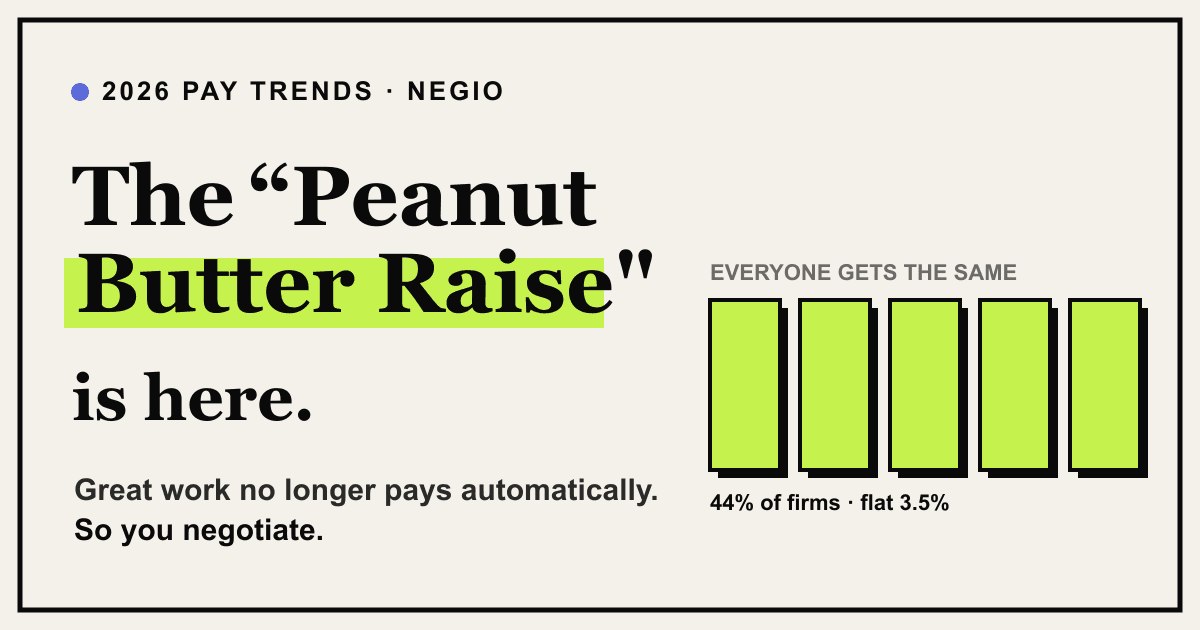
Your raise this year may have nothing to do with how well you performed. In 2026, a growing share of employers are spreading pay increases evenly across everyone — a 'peanut butter' approach that quietly punishes high performers. Here is the data, and the negotiation playbook for getting paid on merit when your company has stopped doing it for you.
The median job search now takes 108 days and two-thirds of seekers have been rejected by an AI before a human ever saw their resume. Mass-applying is dead. Here is the data-backed 2026 playbook for getting hired — and getting paid — faster.
PwC says AI-skilled workers earn 56% more in the same role. The catch nobody writes about: it applies to PMs, marketers, and analysts who can prove shipped impact, not just engineers. Here is how to claim yours before review season closes.
Return-to-office is the pay cut nobody is calling a pay cut. When Fidelity announced the end of hybrid work in early 2026, joining a wave of companies including Amazon, Dell, and JPMorgan, employees did the math and realized something uncomfortable. Their salary had not changed, but their compensation had.
According to analysis published in 2026, RTO mandates consume between 3% and 11% of gross salary in commuting costs, childcare adjustments, work clothing, and lunches out. That is closer to 10 to 15% of net take-home pay when you measure against what actually lands in your bank account. The average RTO worker is out roughly $561 every month in expenses they did not have when working from home.
That is not a perk being removed. That is a pay cut. And in 2026, the only way to get it back is to negotiate for it.
Before you negotiate for flexibility, you need to know what it is worth. The data is striking.
Plug those numbers into your own situation. If you earn $90,000 and your company calls you back five days a week, you are absorbing roughly $7,000 in new expenses, plus 2 to 3 hours a day of unpaid commute time. That is the equivalent of a salary that just dropped to $83,000, except your job posting still says $90,000.
Here is what makes 2026 different. The leverage workers had during the 2021-2022 talent war is gone.
A year ago, 51% of U.S. workers told Yahoo Finance they would quit immediately rather than accept a mandatory RTO. Today, that number is 7%. Another 74% expect to have the same or less bargaining power to demand flexibility in 2026 than they had in 2025.
That is a real shift. But it does not mean the math has changed. Flexibility is still worth 8 to 25% of comp. Companies still benefit when you stay. The difference is that you cannot win this negotiation with an ultimatum anymore. You have to win it with structure.
Negio's salary coach was built for exactly this kind of conversation, where the leverage is real but subtle, and the wrong opening line costs you the deal.
The biggest mistake people make in RTO negotiations is treating flexibility as a personal preference instead of a compensation lever.
When you say "I would prefer to work from home two days a week," you are asking for a favor. When you say "Based on Stanford's WFH research, hybrid arrangements are valued at an 8% comp equivalent. I am open to discussing how that lines up with the base salary on the table," you are negotiating.
The framing matters because compensation is what budgets exist for. Favors are what get cut first.
The Harvard Program on Negotiation has long emphasized that the most effective negotiators frame asks as solving a shared problem. You are not demanding a perk. You are flagging a gap between the role's market value and what is on the table once you account for full-time office work.
Ready to put this into action?
Negio builds a personalized negotiation strategy based on your role, market rate, and situation, backed by the same research you just read.
Try Negio freeVague asks lose. Specific numbers win. Before any conversation, calculate exactly what RTO costs you.
| Expense | Monthly Estimate |
|---|---|
| Commute (gas, transit, parking) | $200 to $400 |
| Lunches and coffee out | $200 to $300 |
| Childcare or after-school | $400 to $1,200 |
| Work clothing and dry cleaning | $50 to $100 |
| Pet care (walker, daycare) | $100 to $300 |
| Total monthly | $950 to $2,300 |
| Annualized | $11,400 to $27,600 |
If your number lands at $15,000 per year, that is the gap you are negotiating to close. You can close it through base salary, a remote work allowance, additional days from home, or some combination of all three.
Negio's negotiation planner builds this calculation into a downloadable strategy document with your specific numbers, the market data backing them, and the language you can use word for word.
"I would like more flexibility" is a wish. Specific trade-offs are a negotiation. Pick from this menu of asks, in rough order of how much budget they require from your employer.
Lowest cost to employer (highest probability of yes):
Medium cost:
Higher cost (need stronger leverage):
The right ask depends on your role, your leverage, and what your manager is empowered to approve. The wrong ask is the one you have not thought through.
When the conversation happens, your opening should be grounded in data, not personal grievance.
Weak: "The commute is killing me and I am exhausted."
Strong: "Based on the comp benchmarks for this role and the Stanford research showing hybrid arrangements are valued at an 8% raise equivalent, I want to discuss how a two-day remote schedule lines up with the offer. If full-time in-office is non-negotiable, I would want to talk about adjusting the base by approximately $7,000 to account for the difference."
Notice the structure:
This is anchoring. The first specific number on the table shapes the entire conversation. If you let your employer name the number first, the negotiation orbits around their anchor, and their anchor is "we already pay you a salary."
The single most important thing you can do before any RTO negotiation is decide, in advance, what number and what arrangement would make you decline or quit.
Maybe it is "anything less than two days remote and I keep job searching." Maybe it is "no salary adjustment but a $300 per month commute stipend is enough." Maybe it is "fully in-office is fine if base goes up by $10,000."
Whatever it is, write it down before the conversation. Your walkaway number is your anchor against pressure tactics, urgency, and the natural human tendency to accept what is in front of you when the alternative is uncertain.
Built In's analysis of counter offers reinforces what every serious negotiation guide says. Accepting a number you resent is a recipe for job-searching again in six months, from a weaker position, because you are now the "short-tenure person" on your resume.
Some companies will tell you flexibility is off the table. Sometimes that is true. Often it is a posture.
If it is true, your conversation shifts to base salary, signing bonus, additional PTO, accelerated promotion, equity, or relocation support. Total compensation is almost always more flexible than base salary alone. A 5-day in-office role that pays $15,000 more than a hybrid role might be a better deal, if the math works after expenses.
If it is a posture, you can test it. "I understand the policy. Is there a path to revisit this in six months based on performance?" or "Could we structure a trial period?" These questions cost nothing to ask and frequently surface flexibility that was never going to appear if you accepted the first answer.
Practicing the pushback is what separates people who fold from people who hold their position. Negio's practice mode puts you in a simulated conversation with a manager who will tell you the policy is fixed, and you can rehearse exactly how to respond before it matters.
| Stat | Finding | Source |
|---|---|---|
| Worker valuation of hybrid | 8% raise equivalent | Stanford WFH Research |
| Tech worker valuation of fully-remote | Up to 25% of total comp | 2026 SWE benchmarks |
| Average monthly RTO cost | $561 | 2026 RTO research |
| RTO as % of gross salary | 3 to 11% | 2026 RTO research |
| RTO as % of take-home pay | 10 to 15% | 2026 RTO research |
| Workers who would quit over RTO (2025) | 51% | Yahoo Finance |
| Workers who would quit over RTO (2026) | 7% | Yahoo Finance |
| Workers expecting less leverage in 2026 | 74% | Yahoo Finance |
Flexibility is no longer a benefit your company hands out. It is compensation you negotiate for, the same way you negotiate base salary, equity, or a sign-on bonus. The companies pushing RTO know exactly what hybrid is worth. That is why they are rolling it back. Now you need to know it too.
If RTO is on the table at your job, do not accept it as a neutral policy change. It is a 7 to 15% reduction in your take-home pay, and you have every right to ask what is being offered to offset it. The data is on your side. The framing is on your side. The only question is whether you walk in prepared to use both.
Build your RTO negotiation strategy with Negio. Calculate your real cost, anchor with the right data, and practice the conversation before your manager schedules it. Free to try, ten messages with a coach trained on the 2026 research.
Sources: The Interview Guys, RTO Mandate Backfire, Yahoo Finance, RTO Compliance 2026, KORE1 Remote Work Statistics 2026, Daily Dev, 2026 SWE Compensation Benchmarks, Harvard Program on Negotiation, Built In, Counter Offer Strategy, Metaintro, Fidelity Ends Hybrid 2026