As of 2026, 16 states require some form of pay transparency, including California, Colorado, New York, Washington, Illinois, Minnesota, New Jersey, and Massachusetts. California's SB 642 took effect January 1, 2026, expanding the state's existing requirements with stricter good-faith pay scale rules and a salary history ban. Another 10 states have introduced bills that have not yet passed.
No. Pay ranges are a starting point, not a final offer. Employers post ranges to comply with the law, but the upper end of those ranges is almost always negotiable based on experience, skills, and competing offers. Research from the Harvard Program on Negotiation shows that anchoring within or above the posted range is one of the most effective strategies in a transparent market.
No. The National Labor Relations Act (NLRA) protects most employees in the United States who discuss wages with co-workers, and many states also have explicit pay discussion protections. Employer policies that prohibit pay discussions are generally unenforceable, and retaliation for discussing pay is illegal in most cases.
Treat the top of the range as the floor for your negotiation, not the ceiling. Anchor with a specific number at or just above the top of the band, justify it with market data and your specific contributions, and frame the conversation collaboratively. If you have AI skills or specialized experience that warrants going above the band, bring data showing what those skills command in the open market.
The median job search now takes 108 days and two-thirds of seekers have been rejected by an AI before a human ever saw their resume. Mass-applying is dead. Here is the data-backed 2026 playbook for getting hired — and getting paid — faster.
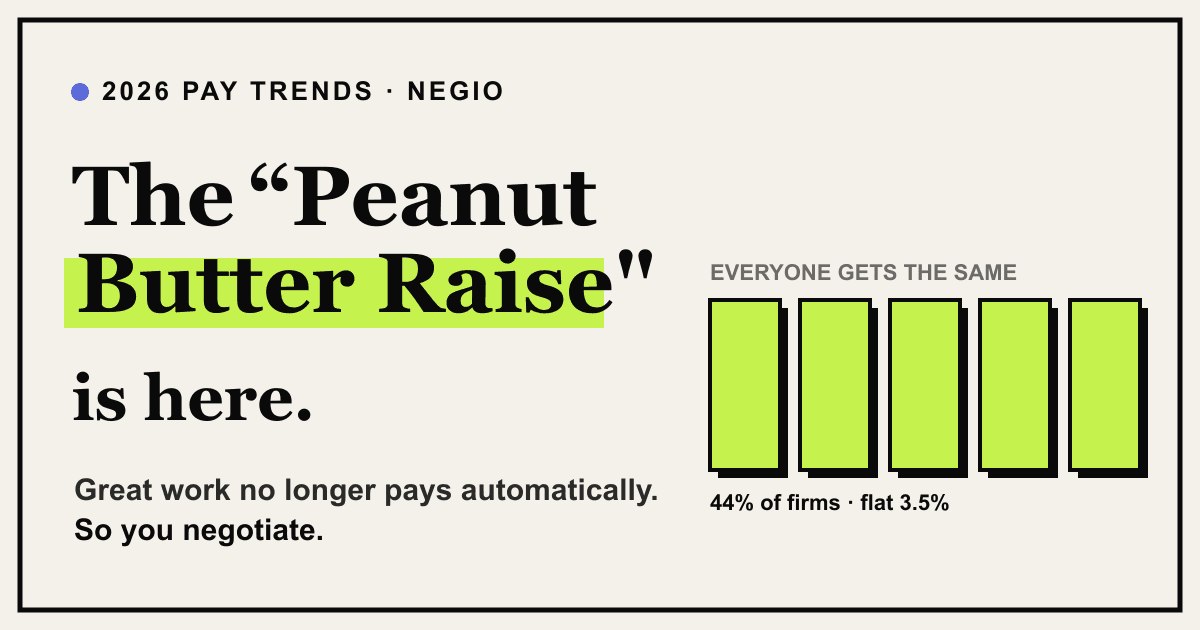
Your raise this year may have nothing to do with how well you performed. In 2026, a growing share of employers are spreading pay increases evenly across everyone — a 'peanut butter' approach that quietly punishes high performers. Here is the data, and the negotiation playbook for getting paid on merit when your company has stopped doing it for you.
PwC says AI-skilled workers earn 56% more in the same role. The catch nobody writes about: it applies to PMs, marketers, and analysts who can prove shipped impact, not just engineers. Here is how to claim yours before review season closes.
Pay transparency just rewrote the rules of salary negotiation. As of January 1, 2026, California's SB 642 requires employers to provide a "good faith estimate" of the pay range for any open role, bans them from seeking salary history, and forces three-year record retention on every pay disclosure. California is not alone. 16 states now have pay transparency laws on the books, and 10 more have bills moving through their legislatures.
The math has shifted in your favor. For the first time in modern hiring history, you can walk into a salary conversation already knowing the band. The question is not whether you have data. The question is whether you know how to use it.
Here is what changed in 2026, and exactly how to turn the new transparency rules into a higher offer.
Pay transparency laws vary by state, but the core requirements have converged on three pillars:
Posted salary ranges. Most states now require employers to include a salary range in job ads. The range must be a "good faith" estimate of what the employer reasonably expects to pay for the role. Vague ranges (e.g., "$50,000 to $250,000") are increasingly being challenged as non-compliant.
Salary history bans. Employers in states like California, Massachusetts, and New York cannot ask about your past compensation. This breaks the cycle where past underpayment locks in future underpayment. You start every negotiation on the merits of the role, not your old paycheck.
Pay disclosure on request. Even where job ads are not legally required to include ranges, current employees and candidates can usually request the pay scale for their role. Refusing to disclose can trigger fines.
Penalties have teeth. California fines range from $100 per violation up to $10,000 for repeat offenses. New York City penalties for unremedied violations can reach $250,000. Compliance is no longer optional, and that creates leverage for you.
Here is the most common misconception about transparent salary ranges: people assume the posted band is the maximum they can earn. It is not.
A posted range is the employer's starting position. It is what they expect to pay for an "average" candidate at that level. If you have above-average skills, a strong track record, or in-demand specializations, you have every right to anchor at the top of the band, or above it.
Decades of negotiation research from the Harvard Program on Negotiation confirm that the first number in a conversation shapes the entire outcome. The work of Galinsky, Ku, and Mussweiler found that the first offer explains 50 to 85% of the variation in final negotiated outcomes.
Pay transparency hands you the data to anchor with confidence. A posted range of "$110,000 to $135,000" tells you exactly where the employer is mentally placing the role. Your job is to give them a reason to land you at or above the top.
This is exactly what Negio's salary coach was built to do: combine the posted range with real-time market data and your specific contributions, then build an anchor strategy that pulls the offer toward your target.
The macro picture in 2026 is mixed, and understanding it sharpens your negotiation.
Base raises are modest. Most U.S. employers are budgeting between 3.5% and 4% for merit increases this year, according to SHRM and WTW. Robert Half's 2026 Salary Guide reports tech salary gains of just 1.6% on average. If you are relying on the standard cycle, your raise will likely fail to keep up with inflation.
Layoffs are still hitting hard. As of mid-April, 95,878 tech workers have been laid off across 249 announcements in 2026. Oracle alone announced cuts of 10,000 to 30,000. Meta cut roughly 1,500 from Reality Labs. The market feels fragile, which makes some candidates hesitant to push.
But specialized skills command huge premiums. PwC's 2025 Global AI Jobs Barometer found that workers with AI skills earn a 56% wage premium over colleagues doing the same job without those skills, up from 25% the year before. AI roles command a 28% premium over traditional tech roles. Mid-level cybersecurity engineers with seven to nine years of experience are seeing salaries up 10 to 15%.
Job switchers still win. Robert Half data shows professionals who change employers are earning 15 to 25% more on average. The gap between staying and switching has rarely been wider.
The takeaway: averages are a trap. If you have specialized skills or a track record that makes you above-average, the posted range is a starting line, not a finish line.
Ready to put this into action?
Negio builds a personalized negotiation strategy based on your role, market rate, and situation, backed by the same research you just read.
Try Negio freeHere is a practical playbook for using transparent pay ranges as leverage.
Step 1: Treat the top of the band as your anchor floor. If a role is listed at $110,000 to $135,000 and you have the qualifications, your opening number should be at or just above $135,000. A range of $138,000 to $142,000 (a "bolstering range") signals confidence and flexibility, which research consistently shows produces better outcomes than a single round number.
Step 2: Justify with specifics, not generalities. Saying "I think I should be at the top of the range" is weak. Saying "Here are three measurable contributions from my last role that map directly to the priorities you described, and they justify the top of the band plus a premium for AI tooling experience" is strong.
Step 3: Use the salary history ban to your advantage. In states with salary history bans, you do not have to disclose what you currently earn. If asked, redirect: "I am focused on what this role pays in the market for someone with my skills, which based on the posted range and my research is $138,000 to $142,000."
Step 4: Bring AI premium data if it applies. If your role involves any AI tooling, automation, or specialized technical skills, pull the PwC data showing the 56% premium. You are not asking for a favor. You are asking the employer to match the open market.
Step 5: Anchor written, negotiate live. Make your initial counter in writing (email or applicant tracking system message) so the number is documented. Then schedule a call to discuss it. Written anchors stick. Verbal anchors drift.
Negio's negotiation planner builds this entire playbook for you. It pulls the posted range, layers in market data for your specific role and location, factors in any AI or specialized skill premiums, and outputs a complete strategy with your anchor number, justification, and concession plan.
One of the quietest but most consequential effects of the 2026 transparency laws is cultural: people are talking about pay more openly than they have in decades.
The legal protection is older than you think. The National Labor Relations Act has protected most U.S. employees' right to discuss wages with coworkers since 1935. Employer policies that prohibit pay talk are generally unenforceable, and retaliation for discussing pay is illegal in most cases.
Internal data beats market data. Knowing what the market pays is useful. Knowing what your specific employer pays your specific peers is more useful. If you find out a colleague with similar tenure and responsibilities is earning $15,000 more than you are, you have a precise, internal data point that is hard to ignore.
Approach it carefully. You do not need to ask coworkers for their exact salary. A simple "I am thinking about pushing for a raise. Would you be open to comparing notes on what we are earning so I can benchmark?" is enough. Most people will share if they trust you.
Sometimes employers will hide behind the posted range and claim "that is the band, take it or leave it." This is rarely true, but it is a common tactic.
Push for total comp, not just base. If base salary is genuinely capped, signing bonuses, equity, additional PTO, accelerated promotion timelines, professional development budgets, and remote work flexibility all have real financial value. Many of these have looser internal approval processes than base pay.
Get a written timeline for the next review. "If we cannot move on base today, what specifically would need to be true for me to be at $X six months from now?" This converts a "no" into a future commitment with measurable terms.
Use the data point in your next move. If your current employer truly cannot meet a market-rate offer, that is critical information. It tells you that the only way to capture your market value is to switch. The 15 to 25% job switcher premium is not theoretical. It is what the market is willing to pay you right now.
Negio's practice mode lets you rehearse the "the range is final" pushback before you hear it for real. After 10 to 15 minutes of practice, the conversation feels familiar instead of stressful.
Here are the numbers worth remembering:
| Stat | Finding | Source |
|---|---|---|
| States with pay transparency laws | 16 (10 more pending) | Paycor / Jackson Lewis |
| California SB 642 effective date | January 1, 2026 | Jackson Lewis |
| Average 2026 merit raise | 3.5 to 4% | SHRM / WTW |
| AI skills wage premium | 56% | PwC Global AI Jobs Barometer |
| AI roles vs traditional tech | +28% | Ravio |
| Job switcher premium | 15 to 25% | Robert Half |
| Tech layoffs in 2026 (YTD) | 95,878 | InformationWeek |
| Maximum NYC pay disclosure penalty | $250,000 | NYC enforcement |
Pay transparency is not a gift to job seekers. It is leverage, but only if you use it. The employer who posts a $110,000 to $135,000 band already knows that some candidates will accept the bottom of the range without asking. The transparency laws hand you the data. The negotiation is still up to you.
In a year of modest base raises, ongoing layoffs, and real premiums for specialized skills, the cost of accepting the default has never been higher. The cost of preparing properly has never been lower.
Start your salary negotiation with Negio -- pull the market data, layer in any specialized skill premiums, build your anchor strategy, and practice the conversation before you sit down. Free to try, no credit card, ten messages with a coach who has read the research so you do not have to.
Sources: Jackson Lewis -- Navigating 2026 Pay Transparency Laws, Paycor -- 2026 Pay Transparency Laws by State, SHRM Salary Increase Projections, WTW Compensation Survey, Robert Half 2026 Salary Guide, PwC Global AI Jobs Barometer via Ravio, InformationWeek 2026 Tech Layoffs Tracker, Harvard Program on Negotiation, AAER -- 2026 New Era of Pay Transparency