Start by researching your market rate, then write a concise email that opens with gratitude, presents your accomplishments with specific metrics, references market data, states your target number, and closes with a collaborative tone. Keep it professional and data-driven, not emotional.
Research from HBR suggests having the raise conversation at the beginning of the year when goals and budgets are being set, not at year-end performance reviews when budgets are already locked. Also ask after a big win, successful project, or when you've taken on additional responsibilities.
Include: specific accomplishments with measurable results (revenue generated, costs saved, projects delivered), market rate data for your role, any additional responsibilities you've taken on, and a specific salary target. Avoid vague language or emotional appeals.
Generic AI tools give generic advice. Specialized tools like Negio analyze your specific role, market rate, experience, and situation to generate personalized negotiation scripts and email templates that are tailored to your exact circumstances.
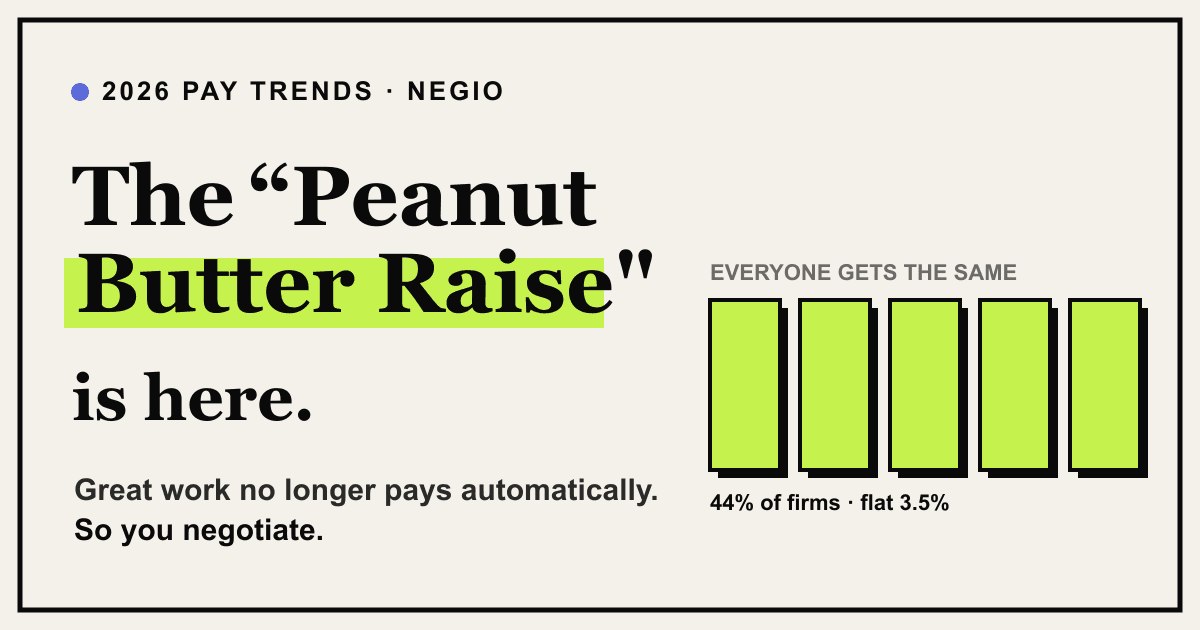
Your raise this year may have nothing to do with how well you performed. In 2026, a growing share of employers are spreading pay increases evenly across everyone — a 'peanut butter' approach that quietly punishes high performers. Here is the data, and the negotiation playbook for getting paid on merit when your company has stopped doing it for you.
The median job search now takes 108 days and two-thirds of seekers have been rejected by an AI before a human ever saw their resume. Mass-applying is dead. Here is the data-backed 2026 playbook for getting hired — and getting paid — faster.
PwC says AI-skilled workers earn 56% more in the same role. The catch nobody writes about: it applies to PMs, marketers, and analysts who can prove shipped impact, not just engineers. Here is how to claim yours before review season closes.
Asking for a raise is one of those things that sounds simple until you actually have to do it. You know your worth. You've done the work. But staring at a blank email draft, trying to find the right words? That's where most people get stuck.
HBR research shows that framing matters enormously in raise requests. Complaints and ultimatums backfire. Data-driven, value-focused asks succeed. And a Harvard podcast on the topic makes the point that getting a raise is a process, not a single conversation.
Below are five copy-paste email templates for the most common raise scenarios. Each one is grounded in what the research says works. And at the end, we'll show you how Negio can generate a fully personalized version based on your actual role, market data, and accomplishments.
When to use it: Your performance review is coming up, or you're scheduling a compensation discussion.
Subject: Compensation Discussion -- [Your Name]
Hi [Manager's Name],
Thank you for the feedback during our recent review. I'm proud of what we've accomplished this year, and I'm excited about what's ahead.
I wanted to open a conversation about my compensation. Over the past year, I've [specific accomplishment #1 with metrics], [specific accomplishment #2 with metrics], and [specific accomplishment #3]. These contributions have directly impacted [team/company goal].
I've researched market compensation for [your role] in [your city/region] and found the current range is [X to Y]. Given my experience and the results I've delivered, I believe an adjustment to [your target number] would reflect my contributions and align with market rates.
I'd love to discuss this at your convenience. I'm committed to continuing to deliver at this level and am enthusiastic about growing with the team.
Best, [Your Name]
Why this works: Research from Glassdoor shows that tying your ask to specific, measurable results is the single most effective strategy. Vague claims like "I've been working hard" carry far less weight than "I increased retention by 15%."
When to use it: You just shipped a major project, closed a big deal, or delivered results that clearly exceeded expectations.
Subject: Quick Follow-Up on [Project Name]
Hi [Manager's Name],
I'm still riding the momentum from [project/deal/launch]. Seeing [specific result -- revenue generated, users acquired, problem solved] come together was incredibly rewarding, and I'm grateful for the trust you placed in me to lead it.
This feels like a natural moment to discuss my compensation. The [project] delivered [specific metric], which [exceeded target / saved $X / generated $Y]. Combined with my work on [other recent contributions], I believe my impact has grown significantly.
Based on market data for [role] in [location], professionals delivering at this level are compensated in the range of [X to Y]. I'd like to discuss adjusting my salary to [target number] to reflect the value I'm bringing.
Would you have time this week or next to chat about this?
Thanks, [Your Name]
Why this works: Deepak Malhotra's research at Harvard emphasizes that timing matters. Asking right after a visible win creates what psychologists call a "peak-end" effect -- your contributions are top of mind and impossible to dismiss.
When to use it: Your responsibilities have expanded, you've been promoted without a corresponding raise, or you're doing a more senior role without the title change.
Subject: Compensation Alignment with Current Responsibilities
Hi [Manager's Name],
I wanted to talk about something I've been thinking about. Over the past [timeframe], my role has evolved significantly. I've taken on [new responsibilities: managing a team, owning a new product area, leading cross-functional projects], which go beyond my original job description.
I'm happy to take on this work -- it's exactly the kind of challenge I thrive on. At the same time, I want to make sure my compensation reflects the scope of what I'm now delivering.
Market data for [the role you're actually doing] in [location] shows a range of [X to Y]. My current compensation sits below this range. I'd like to discuss an adjustment to [target number] to align with my current responsibilities and market rates.
I value our working relationship and want to approach this collaboratively. When would be a good time to discuss?
Best, [Your Name]
Why this works: HBR research found that 33% of employees who were denied a raise received no rationale at all. By framing your request around the gap between your actual role and your compensation, you make it easy for your manager to build the internal case for your raise.
Ready to put this into action?
Negio builds a personalized negotiation strategy based on your role, market rate, and situation, backed by the same research you just read.
Try Negio freeWhen to use it: You have a competing offer and want to give your current employer a chance to match or beat it. Use this carefully -- only when you genuinely want to stay.
Subject: An Opportunity I'd Like to Discuss
Hi [Manager's Name],
I want to be transparent with you about something. I've received an offer from [Company or "another company"] for a [role] at [salary/total comp]. I wasn't actively looking, but the opportunity came to me.
I want to be clear: I'm not using this as leverage. I genuinely prefer to stay here. The team, the work, and the culture are things I value deeply. But the compensation gap is significant enough that I'd be doing myself a disservice not to raise it.
My current salary is [X]. The offer is [Y]. I believe an adjustment to [your target -- between X and Y, or matching Y] would make this an easy decision for me to stay.
I'd appreciate the chance to discuss this before I respond to the other offer. My timeline is [specific date].
Thank you for understanding, [Your Name]
Why this works: Research from Adam Grant at Wharton shows that transparency and genuine interest create what he calls "relational capital." Counter-offers work best when they're honest, not manipulative. Your manager is more likely to fight for you internally when they believe you actually want to stay.
When to use it: You work remotely and your compensation hasn't been reviewed since the shift to remote, or you've been told your salary reflects a "lower cost of living" location.
Subject: Compensation Review -- Market Rate Alignment
Hi [Manager's Name],
I'd like to revisit my compensation in the context of my current contributions and the evolving market for remote [role] professionals.
Over the past [timeframe], I've [accomplishment #1 with metric], [accomplishment #2 with metric], and [accomplishment #3]. My output and availability have been consistent regardless of location, and I've been told the quality of my work matches or exceeds the in-office team.
The market for remote [role] professionals has matured significantly. Current data shows remote-specific ranges of [X to Y] for my level of experience. My current salary of [current] sits [below/at the bottom of] this range.
I'd like to discuss an adjustment to [target] that reflects both my contributions and the current market reality. I'm also happy to discuss performance benchmarks or milestones if that would be helpful.
Thanks for considering this, [Your Name]
Why this works: The 2026 compensation trends show that location-based pay adjustments are becoming less common as companies compete for remote talent. Framing your ask around output and market rates rather than location puts you on stronger ground.
These templates are a solid starting point. But here's the thing: every raise conversation is different.
Your manager's personality, your company's budget cycle, your specific accomplishments, your market rate for your exact role in your exact location -- all of these variables matter. A template can't account for any of them.
That's the difference between a generic script and Negio.
When you use Negio, you don't get a template. You get a personalized negotiation strategy built from:
The result isn't a fill-in-the-blanks email. It's a fully customized script, strategy, and rehearsal plan built for your specific situation.
Before you hit send on any of these templates, keep these research-backed principles in mind:
1. Lead with value, not need. HBR is clear: framing your request around what you've delivered is far more effective than framing it around what you need. "I generated $200K in new revenue" beats "My rent went up."
2. Use specific numbers. Harvard Program on Negotiation research shows that precise numbers ($78,500 instead of $80,000) are perceived as more researched and lead to better outcomes.
3. Time it right. HBR's podcast research recommends having raise conversations at the beginning of the year when goals and budgets are being set, not at year-end reviews when budgets are locked.
4. Have a BATNA. Knowing your Best Alternative to a Negotiated Agreement gives you confidence. Whether it's another offer, freelance work, or simply the knowledge of your market rate, having a backup plan changes how you communicate.
5. Follow up. If you don't hear back within a week, send a brief follow-up. Persistence (without being pushy) signals that you're serious.
Templates are helpful. Personalized, data-backed scripts are better. Negio analyzes your role, market rate, and situation to generate a custom negotiation strategy and scripts you can actually use.
Or skip the templates -- Negio writes a custom script based on YOUR role, market rate, and company
Sources: HBR -- How to Ask for a Raise (2015), HBR -- 15 Rules for Negotiating a Job Offer (2014), HBR -- Getting a Raise Is a Process (2023), HBR -- How Employees Feel When Raises Are Denied (2018), Harvard PON -- Anchoring, Adam Grant / Wharton, Glassdoor, Robert Half