The 2026 job search is slower and more automated than ever: the median time to a first offer hit 108 days in Q1, up 30% from Q4 2025 (Huntr), and 66% of job seekers report at least one AI rejection. The winning strategy has inverted. Cold applications to job boards convert at 2-3%, while direct outreach to hiring managers converts at 33-80% and referrals — just 7% of applicants — fill 30-50% of roles. Around 70% of jobs are never posted publicly. The job seekers who win in 2026 stop mass-applying, work the hidden market through referrals and direct outreach, and treat salary transparency as a filter. And because 72% of candidates skip postings with no listed pay, the offer stage is now where the real money is won or lost.
According to Huntr's Q1 2026 Job Search Trends Report, the median time from starting a search to receiving a first offer climbed to 108 days — up roughly 30% from Q4 2025 and the slowest pace in a year. That figure is a median, so half of searches take longer. The biggest single lever for shortening it is shifting effort away from cold job-board applications and toward referrals and direct outreach, which convert far faster.
Yes. Industry estimates consistently put around 70% of open roles in the hidden job market — positions filled through referrals, internal moves, and direct relationships before they are ever advertised. Employee referrals make up only about 7% of the applicant pool but account for 30-50% of hires, and referred candidates are 4-5 times more likely to be hired and get hired roughly 30% faster than job-board applicants.
Use it to research, tailor, and sharpen — not to mass-produce. Around 45-70% of job seekers now use generative AI in their search, which means a generic AI cover letter looks like everyone else's. The edge comes from using AI to quantify your accomplishments and tailor each application to the specific role, then having a human voice on top. Employers are also screening with AI: 66% of seekers report at least one AI rejection, so a tailored, outcome-focused resume that survives the filter matters more than volume.
Some companies still omit pay to preserve negotiating leverage or because they operate across states with different disclosure laws. But it backfires: 72% of job seekers say they are less likely to apply when a posting has no salary. Treat a missing range as a question to ask early, not a reason to lowball yourself. If a recruiter won't share a band, that is information about how the offer conversation will go — and a sign to anchor on your own market research instead.
Robert Half's 2026 analysis points to hiring momentum in professional services, healthcare, financial services, and manufacturing, with strong demand for roles like software engineer, customer service specialist, administrative assistant, and senior accountant. Skilled and AI-literate roles command the largest pay premiums, so framing your existing skills in those terms — even in a non-technical job — is one of the highest-leverage moves you can make.
16 states now require employers to publish salary ranges. California's new law took effect this January. Here is how to turn that transparency into a bigger paycheck.
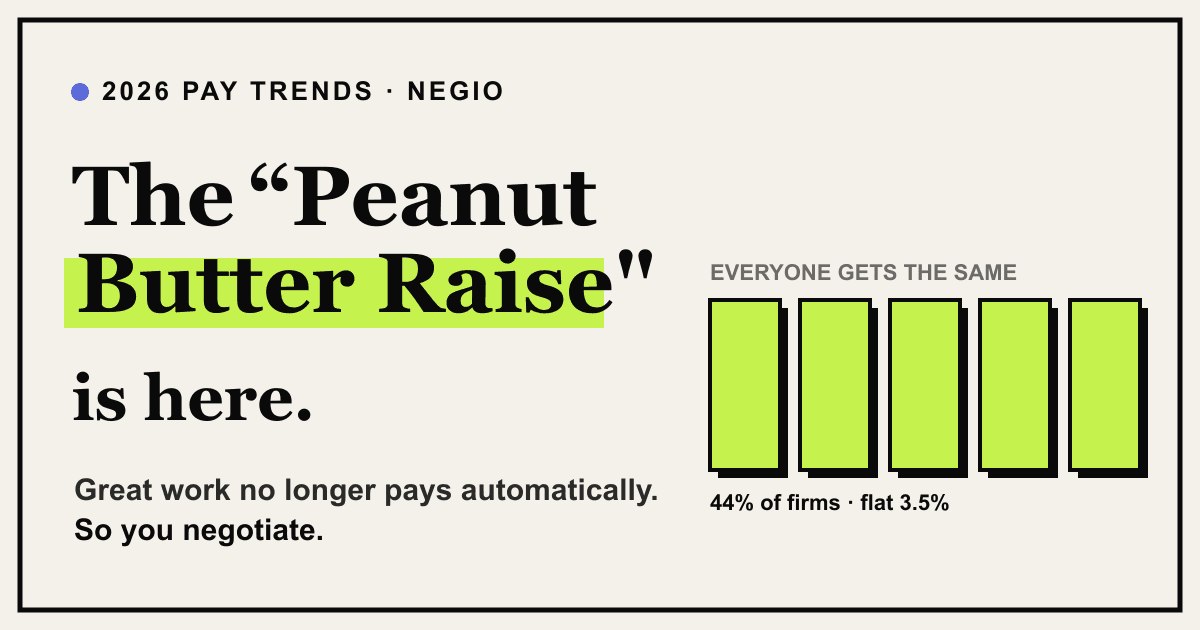
Your raise this year may have nothing to do with how well you performed. In 2026, a growing share of employers are spreading pay increases evenly across everyone — a 'peanut butter' approach that quietly punishes high performers. Here is the data, and the negotiation playbook for getting paid on merit when your company has stopped doing it for you.
PwC says AI-skilled workers earn 56% more in the same role. The catch nobody writes about: it applies to PMs, marketers, and analysts who can prove shipped impact, not just engineers. Here is how to claim yours before review season closes.
The median job search now takes 108 days, and two-thirds of job seekers have been rejected by an AI before a human ever read their resume. That is the headline from Huntr's Q1 2026 Job Search Trends Report: the slowest market in a year, with time-to-first-offer up roughly 30% from Q4 2025. The old playbook — open a job board, apply to 200 roles, wait — is not just inefficient in 2026. It is actively working against you.
Here is what the 2026 data actually says about getting hired, and the strategy that the people landing offers are using instead.
Two forces collided. Applications surged, and AI started doing the screening.
On the supply side, most job postings now receive 200-300 applications, and competitive roles — remote, entry-level, or brand-name employers — routinely exceed 500. On the screening side, employers deployed AI to handle the flood. Industry surveys found that 66% of job seekers report receiving at least one rejection from an AI system, and nearly one in five (18%) believe they lost an opportunity to AI or automation entirely.
The result is an arms race. Around 45-70% of job seekers now use generative AI to research companies and draft applications — which means the average application is more polished and more generic at the same time. When everyone sends an AI-written cover letter, the AI-written cover letter stops being an edge. It becomes noise that another AI filters out.
| Job search channel | Application-to-interview / hire conversion |
|---|---|
| Cold job-board application | ~2-3% (interview), 4-10% (response) |
| Direct outreach to hiring manager | 33-80% response |
| Employee referral | 4-5x more likely to be hired |
The math is brutal and clarifying: the channel most people pour 90% of their effort into is the one that converts worst.
Roughly 70% of open roles are never posted publicly. They are filled through referrals, internal moves, and direct relationships before a job description ever hits a board. By some estimates, around 85% of all positions are ultimately filled through networking rather than public applications.
The referral numbers are the most striking in the entire 2026 dataset. Employee referrals make up only about 7% of the applicant pool but account for 30-50% of all hires. Referred candidates are 4-5 times more likely to be hired, and they get hired roughly 30% faster — typically within 30 days versus 40-45 for job-board hires.
This is why the 108-day median is misleading. It is an average of two very different searches:
You get to choose which search you are running.
You do not need 500 LinkedIn connections. You need a focused list and a repeatable outreach motion.
1. Build a target list of 20-30 companies, not 200 jobs. Pick organizations in industries with 2026 hiring momentum — Robert Half's analysis points to professional services, healthcare, financial services, and manufacturing as the strongest. Quality of fit beats quantity of applications.
2. Find the hiring manager, not the job posting. For each target, identify the person who would manage your role — the engineering lead, the head of marketing, the finance director. Direct outreach to that person converts at 33-80%, versus 4-10% for cold applications. LinkedIn data shows that AI-assisted, personalized messages are 40% more likely to get a response, so use AI to research and tailor, then write in your own voice.
3. Ask for a conversation, not a job. The highest-converting outreach is not "are you hiring." It is "I admire what your team shipped with X, and I'd love 15 minutes to learn how you think about Y." Informational conversations surface unposted roles and turn you into a warm referral instead of a cold resume.
4. Activate dormant referrals. You already know people inside your target industry. A short, specific message — "I'm exploring senior analyst roles in fintech; would you be open to a quick intro if anything fits?" — converts a weak tie into the 7% of applicants who win 30-50% of jobs.
Ready to put this into action?
Negio builds a personalized negotiation strategy based on your role, market rate, and situation, backed by the same research you just read.
Try Negio freeMore than ever — but the job of the resume has changed. In 2026 it has to clear an AI screener and then convince a human in seconds. That means two things.
First, your resume is now a living document, not a static history. Employers in 2026 weight measurable outcomes and impact over task descriptions. "Managed the email program" is invisible to both the AI and the hiring manager. "Grew email revenue 38% by rebuilding the lifecycle flow" survives the filter and earns the call.
Second, every application should be tailored. A generic resume blasted to 200 roles converts at 2-3%. A resume rewritten to mirror the language and priorities of a specific job description clears keyword-based AI screens and signals genuine interest. This is exactly where AI is a genuine asset — not to invent experience, but to pull the quantifiable wins out of your real history and phrase them in outcome terms.
Negio's resume reviewer is built for precisely this: it reads your existing experience and rewrites it into the impact-first, screener-friendly bullets that get past the AI and land with the human behind it.
It has become a filter that works in both directions, and most candidates are not using it.
72% of job seekers say they are less likely to apply when a posting does not list a salary. Pay transparency laws have spread, and candidates have learned to treat a missing range as a yellow flag. But the strategic move is not to skip those roles automatically — it is to surface the number early and let it filter for you.
When a recruiter won't share a band up front, that is information about how the entire offer conversation will go. It tells you to do your own market research and anchor on it rather than on whatever they eventually float. The candidates who get paid the most in 2026 walk into the process already knowing the market range for the role — so the conversation is about where in the band they land, not whether the company's first number is fair.
The offer. And it is the stage almost everyone under-plays after a 108-day grind.
After three-plus months of searching, the temptation to accept the first number is enormous. That fatigue is exactly what costs people the most money. The salary you negotiate at offer time compounds for the entire tenure of the job — every future raise, bonus, and equity grant is calculated off that base. A single conversation at the end of the search is worth more than dozens of applications at the start of it.
The 2026 market actually strengthens your hand here, even in a slow hiring environment:
Negio's negotiation planner turns that final conversation into a scripted, data-backed strategy: your market anchor, the exact language to counter a lowball, and the non-salary levers (sign-on, equity, start date, remote flexibility) most candidates forget to ask for. The free tier covers your first negotiation — and the upside on one offer dwarfs the cost of the entire job search.
If you remember one shift, remember this: in 2026, effort spent on relationships beats effort spent on applications by an order of magnitude. Stop mass-applying into AI screeners. Build a short target list, reach the hiring managers directly, get referred, and then — when the offer comes after that long search — negotiate like the months of work were worth it. Because they were.