← all articles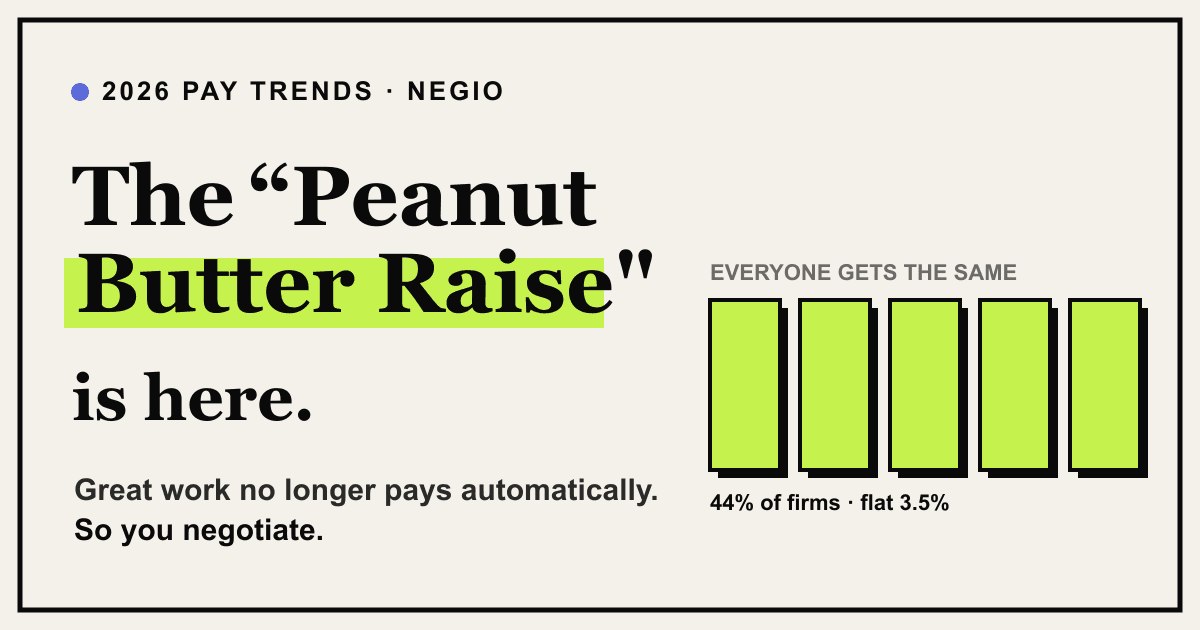
insights
what is a 'peanut butter raise' — and why does it make negotiation essential in 2026?
The breakout 2026 pay story is the 'peanut butter raise' — flat, across-the-board increases that replace merit-based differentiation. Payscale found 44% of organizations are using or considering the approach, and only 48% still plan to differentiate raises by performance, even as median budgets hold flat at 3.5%. Notably, 56% of companies that beat their revenue targets are leaning into peanut butter raises too — so strong results no longer guarantee strong pay. When your employer stops rewarding performance automatically, negotiation becomes the only mechanism left to get paid for it. And the upside is real: people who negotiate land an average of 18.8% more, and roughly 85% who ask succeed in improving the offer.
A 'peanut butter raise' is a pay increase spread evenly across an entire team or company, regardless of individual performance — the budget gets smeared thin and uniform, like peanut butter on bread. Instead of high performers getting a 6% bump and average performers getting 2%, everyone gets roughly the same modest increase. Payscale's 2026 data found that 44% of organizations are using or considering the approach, a notable shift away from the merit-based differentiation that dominated the last decade.
Less reliably than it used to. Only about 48% of organizations still plan to differentiate raises based on performance, and strikingly, around 56% of companies that expected to beat their 2025 revenue goals are using or considering peanut butter raises anyway. That means even at successful, profitable employers, doing great work no longer automatically translates into a bigger raise. The reward for high performance increasingly has to be asked for, not assumed.
People who negotiate land an average of roughly 18.8% more than those who accept the first number, and about 85% of those who negotiate succeed in improving the offer in some way. Over 70% of hiring managers expect candidates to negotiate and do not think less of them for it. In a peanut butter year — when across-the-board budgets are capped near 3.5% — that negotiated difference is often larger than the raise itself.
Decouple your ask from the annual cycle. Flat raises are a budgeting decision made above your manager's head, so competing for a slice of that pool is a losing game. Instead, build a documented case for an off-cycle or market adjustment: quantify your impact, gather external market data for your role, and frame the conversation around retention and the cost of replacing you. Anchor on a specific number backed by evidence rather than asking for 'more.' A structured plan — like the one Negio's negotiation planner builds — turns that into a scripted conversation rather than a hopeful chat.
It depends on your leverage, but 2026 guidance generally lands between 5% and 20% above your current pay or the initial offer, anchored to market data for your specific role and location. With baseline budgets near 3.5%, asking for a meaningful merit or market adjustment means going beyond the standard pool — so your number should be justified by external benchmarks and your documented results, not by what the across-the-board budget happens to allow.
PwC says AI-skilled workers earn 56% more in the same role. The catch nobody writes about: it applies to PMs, marketers, and analysts who can prove shipped impact, not just engineers. Here is how to claim yours before review season closes.
The median job search now takes 108 days and two-thirds of seekers have been rejected by an AI before a human ever saw their resume. Mass-applying is dead. Here is the data-backed 2026 playbook for getting hired — and getting paid — faster.
When your company calls you back to the office, the salary on paper does not change, but your real take-home does. Here is how to negotiate flexibility as compensation in 2026.
Your raise this year may have nothing to do with how well you did your job. That is the uncomfortable headline behind the breakout compensation story of 2026: the rise of the "peanut butter raise." Instead of rewarding top performers with bigger increases, a fast-growing share of employers are spreading their raise budgets evenly across everyone — smeared thin and uniform, like peanut butter on bread.
The trend has dominated the 2026 pay conversation, with coverage from Fortune, CBS News, and compensation authorities like WorldatWork and Payscale. And it changes the math on getting paid in a way most employees have not caught up to yet. Here is what the data says — and why it makes negotiation more essential than at any point in the last decade.
A peanut butter raise is an across-the-board pay increase applied evenly to a whole team or company, regardless of individual performance. Rather than a high performer getting 6% while an average performer gets 2%, everyone gets roughly the same modest bump.
For years, the dominant model was merit-based differentiation: managers ranked their people, and the raise budget flowed disproportionately to the top. The 2026 shift reverses that logic. According to Payscale's 2026 data, 44% of organizations are now using or considering the peanut butter approach — about 9% already do it, 16% are newly implementing it, and another 18% are considering it. Meanwhile, only 48% still plan to differentiate raises based on performance, down sharply from the near-universal norm of a few years ago.
This is happening against a backdrop of flat budgets. Median U.S. base-pay increases are projected at 3.5% for 2026, unchanged from 2025, with merit budgets closer to 3.2%, per the Conference Board and Payscale. When the total pool is not growing, spreading it evenly means the high performer's "extra" comes out of the same fixed bucket — so the easiest path for a cost-conscious finance team is to stop carving it out at all.
Three forces are driving the shift, and none of them are about your performance.
1. Tighter financial control. Many 2026 employers operate with leaner budgets and more finance-team oversight than in the post-pandemic hiring boom. Raise pools are fixed, reviewed against long-term cost impact, and approved centrally. Flat raises are simpler to model and defend in a budget meeting.
2. Pay compression and fairness optics. With pay transparency laws spreading across more than a dozen states, employers are wary of large visible gaps between employees in the same role. Uniform raises reduce the risk of an awkward, legally fraught conversation about why two people doing similar work are paid differently.
3. Administrative ease and burnout-era morale. Differentiating raises requires defensible performance ratings, calibration meetings, and difficult conversations. Spreading the budget evenly sidesteps all of it — and avoids the morale hit of telling most of the team they are merely "average."
The irony is that the approach often backfires on the very thing it is meant to protect. Ruth Thomas, Payscale's chief compensation strategist, warned that peanut butter raises can dilute accountability and threaten the retention of exactly the people a company most wants to keep.
Here is the data point that should change how you think about your next review: around 56% of organizations that expected to beat their 2025 revenue goals are using or considering peanut butter raises.
Read that again. It is not just struggling companies rationing scarce dollars. Profitable, target-beating employers — the ones that can clearly afford to reward standout work — are also flattening their raises. The old assumption that "if I perform and the company does well, I will be paid for it" is quietly breaking down.
| What used to be true | What 2026 data shows |
|---|---|
| Top performers get the biggest raises | Only ~48% of firms still differentiate by performance |
| A profitable company rewards its best people | ~56% of revenue-beating firms lean toward flat raises |
| The annual review is where merit is paid | Flat pools cap merit before the review even starts |
| Doing great work is enough | Great work now has to be argued for, not assumed |
When performance and pay are decoupled by policy, the only remaining mechanism to reconnect them is the one most people avoid: asking.
Ready to put this into action?
Negio builds a personalized negotiation strategy based on your role, market rate, and situation, backed by the same research you just read.
Try Negio freeIf your raise is set by a flat, company-wide budget, then competing harder for your slice of the annual cycle is a losing game — the size of the pie was decided above your manager's pay grade. The leverage moves elsewhere. Three shifts follow directly from the trend:
The annual review is no longer where your pay is decided. It is where a pre-set number is communicated to you. The real conversation has to happen off-cycle, framed differently, and backed by evidence.
Your manager is now an ally, not a gatekeeper. Under a flat-raise policy, your manager often cannot give you more from the standard pool even if they want to. The productive ask is for help building a case for an off-cycle or market adjustment — a separate budget line that exists precisely for retention risks.
External market data is your strongest weapon. When internal raises are deliberately uniform, the gap between your pay and the open-market rate for your role is where your argument lives. Companies that flatten internal raises still pay market rate to replace someone who leaves — and reminding them of that, professionally, is leverage.
And the upside is not marginal. People who negotiate land an average of roughly 18.8% more than those who accept the first number, and about 85% of those who negotiate succeed in improving their outcome. In a year when the across-the-board raise is capped near 3.5%, a successful negotiation is often worth several times the raise itself.
The strategy is not to fight for a bigger flat raise. It is to argue you are a special case that warrants a separate adjustment. Here is the playbook.
1. Document impact continuously, not annually. Keep a running record of what you shipped, the revenue you influenced, the costs you cut, and the problems only you solved. Quantify everything. When raises are flat by default, a specific, dollar-denominated story is what justifies an exception.
2. Anchor on external market data, not internal comparisons. Pull current benchmarks for your exact role, level, and location. The question you are implicitly raising is not "why am I paid the same as my teammate" — it is "why am I paid below what the market would pay me tomorrow." That reframes the conversation around retention risk, which is a budget item even cost-conscious companies fund.
3. Decouple your ask from the review cycle. Request a market or equity adjustment as a separate conversation, ideally after a visible win. Off-cycle adjustments often come from a different budget than the annual pool — the one that exists to keep flight risks from leaving.
4. Frame it around the cost of replacing you. Replacing an employee typically costs a significant fraction of their annual salary in recruiting, onboarding, and lost productivity. A targeted raise to retain a proven performer is almost always cheaper than backfilling the role. Make that math easy for your manager to carry upstairs.
5. Anchor on a specific, evidence-backed number. Do not ask for "more." Ask for a defined figure — typically 5% to 20% above your current pay depending on your leverage and the market gap — and back it with the benchmarks and impact record you assembled. Vague asks get vague answers; specific asks force a specific response.
6. Bring the non-salary levers too. If the cash budget is genuinely frozen, redirect toward a one-time bonus, additional equity, a title change that resets your band, a development stipend, or remote flexibility. These often sit outside the flat-raise pool entirely.
This is exactly the kind of conversation Negio's negotiation planner is built for: it turns your impact record and market data into a scripted, data-backed strategy — your anchor number, the language to counter a "budgets are flat this year" deflection, and the non-salary levers most people forget to ask for. The free tier covers your first negotiation, and the upside on a single successful ask dwarfs a year of peanut butter.
That sentence is a deflection, not an answer — and it is the single most common response you will hear in a peanut butter year. Three ways to handle it:
If you remember one thing, remember this: in 2026, performance and pay have been quietly decoupled — and negotiation is the only thing left to reconnect them. When your employer stops rewarding great work automatically, the raise you earn is increasingly the raise you ask for. Document your impact, anchor on the market, make the case off-cycle, and treat the conversation as the highest-leverage hour of your year. Because in a peanut butter year, it is.