Yes, but the type of AI matters enormously. Generic AI chatbots give generic advice like 'research your market rate' without actually doing the research. Specialized AI tools like Negio pull real market data, build personalized strategies, and let you practice with a simulated hiring manager.
Generic AI gives one-size-fits-all advice based on general knowledge. Specialized AI tools are purpose-built for negotiation: they access real salary data, understand negotiation psychology, create tailored scripts for your specific situation, and provide interactive practice with realistic pushback.
For basic tips, maybe. But research from Harvard shows that the most effective negotiation preparation includes specific market data, rehearsal with realistic pushback, and personalized scripts. Generic AI can't provide any of these at the depth needed to move the needle.
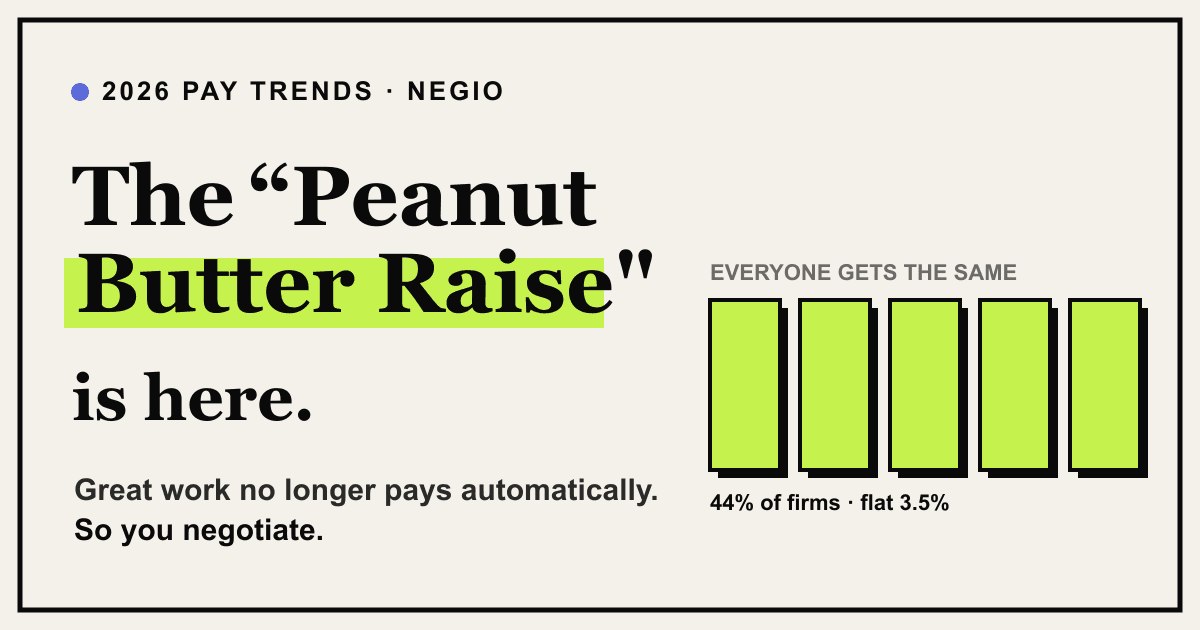
Your raise this year may have nothing to do with how well you performed. In 2026, a growing share of employers are spreading pay increases evenly across everyone — a 'peanut butter' approach that quietly punishes high performers. Here is the data, and the negotiation playbook for getting paid on merit when your company has stopped doing it for you.
The median job search now takes 108 days and two-thirds of seekers have been rejected by an AI before a human ever saw their resume. Mass-applying is dead. Here is the data-backed 2026 playbook for getting hired — and getting paid — faster.
PwC says AI-skilled workers earn 56% more in the same role. The catch nobody writes about: it applies to PMs, marketers, and analysts who can prove shipped impact, not just engineers. Here is how to claim yours before review season closes.
You've probably already tried it. You opened a generic AI chatbot, typed something like "help me negotiate my salary," and got back a tidy list of tips.
Research your market rate. Know your worth. Be confident. Don't accept the first offer.
Great advice. Also completely useless when you're staring at an offer letter at 10pm trying to figure out if $82,000 is fair for a senior product designer in Amsterdam.
Generic AI tools are impressive. They can write poetry, summarize research papers, and explain quantum physics. But salary negotiation isn't a general knowledge problem. It's a specific, personal, high-stakes decision that depends on variables no general-purpose tool can account for.
Here's what happens when you ask a generic AI chatbot to help you negotiate:
You ask: "I got an offer for $85,000 as a data analyst in Chicago. Should I negotiate?"
Generic AI says: "Yes, you should negotiate. Research shows that most employers expect negotiation. Look up market rates on salary comparison websites, prepare your talking points, and be confident in your ask."
That's not wrong. It's just not helpful. It's the equivalent of a doctor saying "eat better and exercise more" when you came in with a specific concern.
What you actually need:
Generic AI gives you step one at a surface level and leaves you to figure out the rest.
When you ask a generic AI chatbot for salary data, you get ranges pulled from its training data, which may be months or years out of date. It can't access live salary databases. It can't account for the difference between a Series B startup and a Fortune 500 company. It can't adjust for your specific certifications, years of experience, or tech stack.
Negio has a dedicated salary research mode that pulls together current market data for your specific role, location, and experience level. The difference between "analysts in Chicago make $70K-$100K" and "data analysts with 4 years of experience and Python/SQL skills in Chicago's fintech sector average $88K-$96K" is the difference between guessing and knowing.
Generic AI is good at explaining concepts like BATNA, anchoring, and the zone of possible agreement. But knowing what BATNA stands for doesn't help you figure out what your BATNA actually is.
HBR research by Deepak Malhotra emphasizes that effective negotiation requires understanding your specific situation: What's your walkaway point? What are your alternatives? What does the employer value most? What's negotiable beyond salary?
Negio's negotiation planner builds a complete, personalized strategy that includes your target number, your walkaway point, your BATNA, and a prioritized list of everything you want to negotiate -- all based on your actual inputs, not hypotheticals.
This is the biggest gap. Research from Alison Wood Brooks at Harvard shows that anxiety causes negotiators to make steep concessions, exit prematurely, and earn less. The most effective intervention for negotiation anxiety? Practice.
You can't practice a negotiation with a generic AI chatbot. It'll play along, but it won't push back realistically. It won't throw the curveball your manager is actually going to use. It won't say "the budget is tight this quarter" with the same tone your HR department will.
Negio's practice mode simulates a real hiring manager or boss who pushes back, asks tough questions, and creates the pressure you'll actually face. After the session, you get a detailed debrief with specific feedback on what worked and what to adjust.
Ask a generic AI chatbot for negotiation help today, come back tomorrow, and you're starting from scratch. There's no continuity. No understanding of your previous conversations, your strategy, or your progress.
Salary negotiation isn't a one-shot event. It's a process that unfolds over days or weeks. You need a tool that tracks your strategy, remembers your market data, and adapts as the situation evolves.
Negio maintains your full negotiation context across conversations. Your strategy, your market research, your practice sessions -- it's all connected.
Generic AI is designed to be helpful and agreeable. That's great for most tasks. It's terrible for negotiation coaching.
When you tell a generic chatbot "I think I should ask for $90K," it'll say something like "That sounds reasonable! Here are some tips for presenting your case." It won't challenge you. It won't say "Actually, the market data suggests you should be asking for $105K. Here's why you're undervaluing yourself."
HBR's analysis of 60,000 negotiation interactions found that the best negotiators are those who challenge assumptions and ask probing questions. Your AI negotiation tool should do the same.
The research is consistent about what separates effective negotiation preparation from surface-level advice:
1. Specific market data -- Not ranges, but precise numbers for your role, location, and experience level. Harvard PON research shows that precise anchors lead to better outcomes than round numbers.
2. A personalized strategy -- Your target, your walkaway, your BATNA, and a plan for concessions. HBR emphasizes that the best negotiators look beyond the immediate conversation and plan multiple moves ahead.
3. Realistic practice -- Rehearsing the actual conversation with someone who pushes back. Harvard research shows this is the #1 intervention for reducing anxiety and improving outcomes.
4. Objection handling -- Prepared responses to specific pushbacks like "the budget is tight," "we don't negotiate at this level," or "we'll revisit in six months." HBR's negotiation toolkit recommends having responses ready for the most common objections.
5. Post-negotiation analysis -- Understanding what worked and what didn't so you improve for next time. Research on negotiation competency shows that reflection and feedback are essential to building negotiation skill over time.
Ready to put this into action?
Negio builds a personalized negotiation strategy based on your role, market rate, and situation, backed by the same research you just read.
Try Negio free| What You Need | Generic AI | Negio |
|---|---|---|
| Market rate for your role | "Check Glassdoor or Levels.fyi" | Researched salary range for your specific role, location, and experience |
| Negotiation strategy | "Know your worth and be confident" | Personalized plan with target, walkaway, BATNA, and concession priorities |
| Scripts | "Here's a generic template" | Custom scripts based on your situation, role, and company context |
| Practice | Agrees with whatever you say | Simulated hiring manager with realistic pushback and objections |
| Objection handling | General tips about staying calm | Specific responses to the exact pushbacks you'll face |
| Resume review | Basic formatting tips | ATS optimization, keyword analysis, and impact scoring |
| Continuity | Starts from zero every time | Remembers your strategy, data, and progress |
The best way to understand the gap between generic advice and personalized preparation is to experience it. Negio gives you the research, strategy, scripts, and practice that actually move the needle.
Try the difference yourself -- free
Sources: HBR -- 15 Rules for Negotiating a Job Offer (2014), HBR -- Emotion and the Art of Negotiation (2015), HBR -- Most Effective Negotiation Tactic (2024), HBR -- What's Your Negotiation Strategy? (2020), HBR -- Negotiate Like a Pro (2024), HBR -- What Makes a Great Negotiator (2025), Harvard PON -- Anchoring